

This is the first question almost every business owner asks us: "How much will my website cost, and when will it be ready?" And the honest answer is always the same: it depends. We know that is not very helpful, so in this guide we will explain exactly what it depends on.
A website is not like buying a product off the shelf. Two sites that look similar can have very different prices because of what is happening behind the screen. Once you understand what drives the cost and the timeline, you can plan your budget properly, compare quotes fairly, and avoid unpleasant surprises halfway through the project.
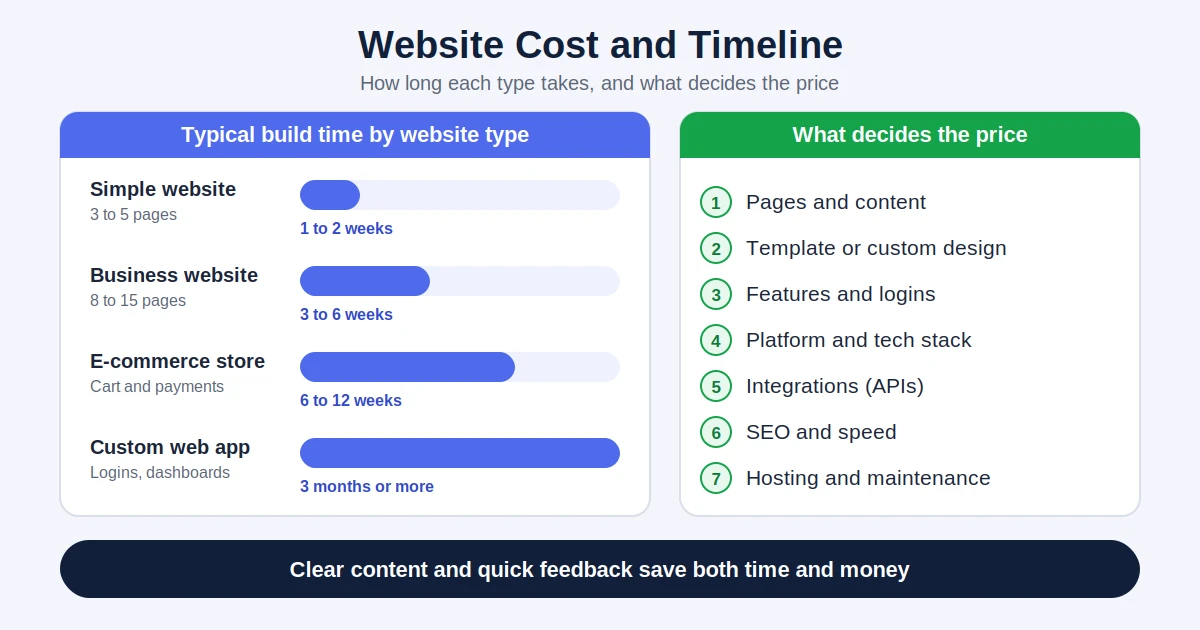
Cost and time usually move together. The more complex the project, the more of both it needs. Here is a rough idea of what to expect for each type of website:
These are general ranges, not promises. Your own project may be faster or slower, depending on the factors below.
Let us go through the main factors one by one. Each of these can move your budget up or down.
More pages mean more design, more development, and more testing. A five-page site and a fifty-page site are very different projects. Content matters here too. If you already have well-written text and good photos, the work moves fast. If the designer has to wait for content, or the content needs to be written from scratch, both the cost and the timeline grow.
A template-based website uses a ready-made layout that is adjusted to your brand. It is quicker and cheaper. A custom design is created from scratch for your business, which takes longer but gives you a look nobody else has. If your brand relies on a strong identity, custom design is usually worth it. It is the same logic we explain in our comparison of Canva vs a professional graphic designer.
A simple contact form is quick. A booking calendar, user login, online payments, a customer dashboard, or a multi-language setup is a different story. Every extra feature has to be built, connected, and tested. This is usually the biggest reason one quote is much higher than another.
The technology behind your site affects both price and flexibility. A WordPress site is faster to launch, while a custom-coded application gives you more control but needs more development time. Choosing the wrong stack can cost you money later, so it is worth reading our guide on how to choose the right tech stack for your business website before you finalise anything.
Do you want your website to talk to WhatsApp, a CRM, payment gateways, email tools, or accounting software? These connections are done through APIs, and each one adds setup and testing work. They are very useful, but they should be planned early so they do not become expensive add-ons later.
A good website is not only about looks. It should load quickly, work well on mobile, and be set up so Google can understand it. Proper SEO structure and speed optimisation take extra effort, but fixing them after launch costs far more. Our guide on website speed and Core Web Vitals explains why this matters so much.
The one-time build cost is not the whole story. A website also needs a domain name, hosting, security updates, and regular backups. These are ongoing costs. Many business owners forget about them until the first renewal bill arrives, so ask about them upfront.
Here is something we see again and again: the development itself is rarely the slow part. Delays usually come from the waiting. Content that arrives late, feedback that takes a week to come back, a logo that is still being decided, or new features added in the middle of the project.
You can keep things on track with a few simple habits:
When you compare quotes, check whether these are included or charged separately:
A quote that looks cheap but leaves out half of this list can end up costing more than one that looked expensive.
The clearer you are, the better the quote. Before you contact any developer or agency, prepare these points:
If you are not sure about some of these, that is fine. A good team will help you figure them out.
Cheap and good rarely come together. A fair quote explains where your money is going.
The goal is not the lowest price. The goal is the best value for the money you spend.
A simple website can take 1 to 2 weeks, a business website 3 to 6 weeks, an e-commerce store 6 to 12 weeks, and a custom web application 3 months or more. Late content and slow feedback are the most common reasons for delays.
Quotes differ because of the number of pages, design type, features, integrations, platform, and the level of testing and support included. Two quotes are only comparable when they cover the same scope.
Usually yes. You will need to renew your domain and hosting every year, and it is wise to budget for security updates, backups, and small content changes. Ask about maintenance plans before you sign.
For a new business with a small budget, a well-set-up template can work well. If your brand depends on standing out, or you need special features, a custom website is the better long-term investment.
Yes, if the website is built properly. Planning for growth from the start makes it much easier and cheaper to add new pages, tools, and features as your business grows.
There is no single price tag for a website, but there is a clear logic behind the cost. Pages, design, features, technology, and ongoing care all play a part, and the timeline mostly depends on how quickly content and decisions come in. When you know these factors, you can ask better questions and choose a partner with confidence.
If you are planning a new website or want to improve your current one, the development team at Alien Web Solutions can walk you through the options and give you a clear, honest quote. Tell us about your business and what you want to achieve, and we will take it from there.
